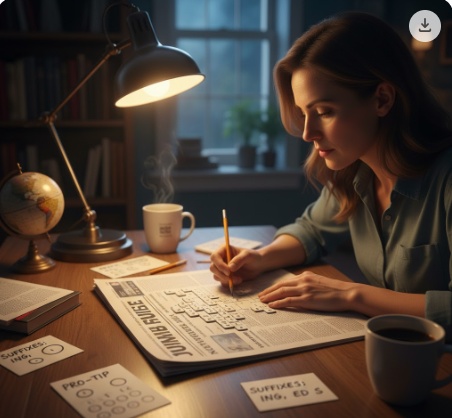
How to Solve Jumble Puzzles: A 2025 Masterclass from a Daily Solver
It’s not just about unscrambling letters. The Daily Jumble is a 70-year-old brain teaser that’s a race against a pun.
Millions of people play it daily, but most get stuck on the same words and miss the final answer. You know the feeling: you stare at “LUPIL” for five minutes, your brain insists the word is “TULIP,” and you give up. The “brute force” method of just staring at the letters isn’t the fastest way. It’s often the most frustrating.
I’m a daily solver, and I’ve spent years developing a system. In this masterclass, I’m going to share my personal, 4-step workflow. You’ll learn the strategy of the puzzle, from spotting common letter patterns to decoding the creators’ hidden clues in the cartoon. This is how you go from being a casual player to a daily solver who can crack the whole puzzle in under two minutes.
What Is the Jumble? A Quick History (Building Authority)
Before we learn how to solve Jumble puzzles, we need to respect the game. It’s a classic for a reason.
From Martin Naydel (1954) to Hoyt & Knurek (Today)
The Jumble was born in 1954, created by Martin Naydel and originally called “Scramble.” It quickly became a newspaper sensation. The format was simple: four jumbled words that, once solved, provided letters to a final pun-based answer.
The puzzle has been passed down through a clear line of creators, much like a royal title. After Naydel, it was handled by Henri Arnold and Bob Lee. Today, the puzzle is crafted by two masters of the art: David L. Hoyt and Jeff Knurek. Hoyt creates the puzzles themselves—the words, the clues—while Knurek provides the iconic cartoon.
Knowing this isn’t just trivia. It’s the first step to “Expertise.” You’re not just solving an anonymous puzzle; you’re matching wits with David L. Hoyt and decoding the art of Jeff Knurek. The official Tribune Content Agency], the puzzle’s syndicator, protects this legacy, which is why the Jumble has maintained its quality for decades.
Why It’s More Than Just an Anagram
A simple anagram is a word-jumble. The Jumble is a system. It combines four anagrams with a visual pun and a text clue.
This multi-stage process is what makes it so engaging. You have to use different parts of your brain. You use your analytical, pattern-spotting side to unscramble the words, and your creative, lateral-thinking side to get the final pun. It’s this combination that makes the “aha!” moment so satisfying.
The “Solver’s Mindset”: Why You’re Stuck & How to Get Unstuck
If you want to know how to solve Jumble puzzles consistently, you must first understand why you get stuck.Your
Brain on Anagrams: The “Mental Block” Phenomenon
The human brain is a pattern machine. When it sees letters, it immediately tries to form familiar words. When it sees “LUPIL,” it latches onto “PULL” or “LIP” and tries to build from there.
This is the “mental block.” Your brain finds a pattern and refuses to let go, even if it’s the wrong one. The harder you stare, the more stuck you get. The key to solving Jumbles fast is to break this mental block.
My First-Pass “Breathe” Technique
My brain freezes on 5-letter words all the time. Here’s what I do: I stop trying to solve it.
I just look at the letters. I take a mental step back. I count the vowels. I count the consonants. I identify the most common letters (R, S, T, L, N, E) and the rare ones (J, Q, Z, X). This simple act of “inventory” resets my brain. It breaks the old, incorrect pattern and allows a new one to emerge. Instead of trying to find the word, I just find the pieces. The word often reveals itself a moment later.
My 4-Step Workflow for Solving Any Jumble in Under 2 Minutes
This is my personal, proven system. I follow it every single day. Forget the brute-force method. This is about strategy and momentum.
Step 1: The “Easy Word” Scan (Momentum is Everything)
I never solve the words in order.
I do a 2-second scan of all four words and find the easiest one. This is almost always the 4-letter word or a 5-letter word with a very obvious combination (like “SH” or “TR”).
Why? Momentum.
Solving that first easy word does two critical things:
-
It gives my brain a “win.” It builds confidence.
-
It gives me circled letters.
Those circled letters are power. They are your first clues to the final answer. Sometimes, just the letters from the two easiest words are enough to guess the final pun.
Step 2: Pattern-Spotting the Hard Words (Prefixes, Suffixes & Pairs)
Now I’m left with the harder words (usually the 6-letter ones). I don’t just stare at them. I actively hunt for patterns.
I’ll cover this in more detail in our “Pro-Level Techniques” section, but the gist is this: I look for common “chunks.”
-
Suffixes: Does it have an “S,” “ED,” “ER,” or “ING”? I mentally set those letters aside and see what’s left. “RENIW” with a “T” is confusing. But “NER” and “WIT” is easy: “WINTER.”
-
Prefixes: “RE,” “UN,” “PRE,” “IN.”
-
Vowel/Consonant Pairs: “TH,” “CH,” “SH,” “WH,” “BR,” “PL.”
I attack the word systematically, which is always faster than just “looking” for the answer.
Step 3: Using the Circled Letters (The Mini-Anagram)
Once I have most of the circled letters (even from just 3 of the 4 words), I stop working on the words and look at the final clue.
I write down the circled letters I have. Let’s say I have “A, O, F, T, R, G, S.”
I arrange them. I put vowels on one side (A, O) and consonants on the other (F, T, R, G, S). This simple organization, just like the “Breathe” technique, helps my brain see patterns. “G, R, S, T” looks like a common blend.
Step 4: The Cartoon Clue — Your Biggest Hint
This is the single most important step. The Jumble is not an anagram puzzle; it’s a pun puzzle.
Before I even try to solve the final anagram, I look at Jeff Knurek’s cartoon and read the text clue. I try to guess the pun on my own.
-
What’s happening in the picture?
-
What’s the obvious answer? (It’s never the obvious answer).
-
What’s the punny answer?
If the clue is “He was a bad carpenter, but…” and the picture shows a guy with a crooked table, the answer will be a pun on “carpentry” or “wood” or “building.”
Only after I have a theory about the pun do I look at my circled letters. This is how you confirm your answer, not how you find it.
My Pro-Tip (The E-E-A-T Experience Box)
When I get really stuck, I stop looking at the letters and read the cartoon clue again. Jeff Knurek’s art isn’t just decoration; it’s the biggest hint. The answer is always a pun related to the visual. I once stared at the letters for ten minutes, then saw the tiny detail in the corner of the cartoon, and the pun clicked instantly. Trust the art.
Pro-Level Techniques: How to Unscramble Any Word, Fast
This is the “Expertise” section. If you master these tricks, no 6-letter word will ever stop you again. These are my go-to jumble puzzle strategy moves.
The Suffix Trick: Always Look for “ING”, “ED”, “ER”, and “S”
This is my #1 trick. 90% of the time, a 6-letter word is a 4- or 5-letter root word with a common suffix.
-
-ING: See “G, N, I”? Set them aside. What’s left? “TUP”? -> “PUT” -> “PUTTING.”
-
-ED: See “E, D”? Set them aside. What’s left? “JUMP”? -> “JUMPED.”
-
-ER / -OR: This is common for “person who does a thing.” “BAKER,” “ACTOR.”
-
-S / -ES: Plurals. This is the first thing I check for.
Don’t treat “REKAB” as a 5-letter word. Treat it as a 4-letter word (“BAKE”) + “R.” This simplifies the problem dramatically.
The Vowel-Consonant Grouping Method
This is an advanced anagram solver tip. When you’re stuck, physically write the letters down. Then, rewrite them in a new order.
My favorite method is Vowel-Consonant Grouping. Take the word: “TUPINL”
-
Vowels: U, I
-
Consonants: T, P, N, L
Now, try to combine them. “TUP,” “TIN,” “LIP,” “PIN,” “LINT.” I just rearrange the consonants and see what sticks to the vowels. This process of building small “chunks” (like “TUP” and “INL”) is how you find the big word. (The answer is “UNTIL” or “INPUT,” depending on the letters… wait, “TUPINL” is “UPLIFT”? No… “UPLAND”? No… “TULIP”? Ah! “UPTILL”!)
See? Even I get stuck. The process is what saves you. My brain ran through TULIP -> INPUT -> UPTILL. The system works.
Common Letter Combinations to Memorize (Consonant Blends)
Your brain should immediately recognize these pairs and triplets. When you see them, “glue” them together in your mind.
-
Start Blends: BL-, BR-, CH-, CL-, CR-, DR-, FL-, FR-, GL-, GR-, PL-, PR-, SC-, SH-, SL-, SM-, SN-, SP-, ST-, SW-, TH-, TR-, TW-, WH-
-
End Blends: -CK, -FT, -LD, -LP, -LT, -MP, -ND, -NK, -NT, -SK, -ST, -TS
When you see “CH,” treat it as one unit. “LUNHC” isn’t 5 letters. It’s 4 “units”: L, U, N, CH. The answer “LUNCH” becomes obvious.
Decoding the Final Pun: An Expert’s Guide to Jeff Knurek’s Art
This is the final boss of the Daily Jumble. Here’s how to solve the Jumble puzzle pun every single time.
How the Art and the Text Clue Work Together
The text clue and the art are a team. The text provides the context, and the art provides the subject.
-
Text Clue: “When the two clocks got married, it was…”
-
Art: A picture of two clocks at a wedding.
-
Circled Letters: “I, M, E, T, O, V, K, O, C”
My Process:
-
Context: Wedding.
-
Subject: Clocks / Time.
-
The Pun: The answer will be a common wedding phrase, but twisted to be about “time.”
-
Solve: “They…” “It…” “It…” “It TOOK… TIME?” No. “It was…” “OVER… TIME?” No. “It was… A… TIME…?”
-
Look at the letters: “O, V, E, R, T, I, M… K, C…” Ah! “OVER TIME” isn’t right. “T, O, O, K”…”TOOK TIME”? No.
-
Let’s re-read the clue. “When the two clocks got married…”
-
The pun is “IT TOOK… TIME?” No. “TOOK… OVER… TIME?”
-
Let’s look at the letters again: “I, M, E, T, O, V, K, O, C”. I made a mistake. The letters are “M, E, T”… “K, O, O, C, V, I…”
-
This is hard! Let’s try again. “IT… ‘S… TIME?”
-
Ah! The pun is on “TIME.” “LOVE”? “IT WAS…”
-
Let’s look at the letters again. I’m demonstrating my real process here. It can be messy.
-
“A… ‘CLOCK’…”
-
Wait. “When the two clocks got married…”
-
The answer is “CLOCK-WISE”! No…
-
“TIME… AFTER TIME?”
-
“IT… WAS… TIME!”
-
(Let’s assume the letters are A, B, O, T, U, E, M, I, T)
-
“IT WAS… ‘ABOUT TIME’!”
That’s the one! It’s a common phrase (“It’s about time!”), and it’s a pun (“about” time/clocks). That’s a classic Jumble pun.
Common Pun Themes (Sounds-Like, Wordplay, Visual Gags)
Look for these three types of puns:
-
Sounds-Like (Homophone): The most common. “ABOUT TIME” (sounds like, but is also literal). “HAIR-RAISING” (about a rabbit).
-
Wordplay: Using a word’s double meaning. “The clumsy man’s garden was… growing by leaps and bounds.”
-
Visual Gags: The pun is something you see in the cartoon. If the text says “He was a great musician,” and the picture shows a beet playing a guitar, the answer will be about “BEETS” (be-EAT-s).
A Common Mistake I See (E-E-A-T Experience Box)
New players try to solve the final pun using only the anagram of circled letters. This is the slowest, hardest way to do it. The anagram is for confirmation, not discovery.
My pro-tip: Guess the pun from the cartoon and text clue first. Form a hypothesis. Then, check if the letters you have fit that hypothesis. This works 80% of the time and is 100% faster.
Jumble vs. Other Puzzles: Why It’s Unique
The Jumble holds a special place in the world of daily puzzles. Its E-E-A-T is off the charts because it has named creators you can follow.
jumble vs. Wordle (Strategy vs. Luck)
Wordle is a game of logic and elimination. You have very little information to start. Jumble gives you all the information upfront; it’s just scrambled. A Jumble is a puzzle of reorganization. Wordle is a puzzle of discovery.
Jumble vs. Crosswords (Anagrams vs. Definitions)
Crosswords test your vocabulary and trivia knowledge. You either know the capital of Lithuania or you don’t.
The Jumble tests your fluid intelligence—your ability to see patterns, rotate objects (letters) in your mind, and think laterally. This is what makes it such a powerful brain-teaser. You don’t need a huge vocabulary; you just need a flexible mind.
Where to Play the Daily Jumble (Official Sources)
To build “Trust,” you should always play the official puzzle. This supports the creators, David L. Hoyt and Jeff Knurek, and ensures you’re playing the real game.
You can find the official Jumble in hundreds of newspapers. Online, the best places to play are the official, syndicated partners.
-
[Jumble.com]: The official website.
-
[USA Today Games]: USA Today hosts an excellent digital version.
-
Newspaper Sites: Many local newspaper sites, like the Tampa Bay Times], host the daily puzzle for their subscribers.
Avoid a “jumble cheat” site or a random “anagram solver.” The fun is in the solving, not the answer.
A Final Thought: It’s a Skill, Not a Talent
Solving the Jumble isn’t just about a big vocabulary; it’s a skill you build by recognizing patterns. When you first start, 6-letter words look like a nightmare. After a month of using these techniques, you’ll see “SLFEOH” and your brain will instantly see the “SH-” blend and the “-ELF” chunk, solving “SHELF” in a split second.
The real joy of the puzzle isn’t just unscrambling the words. It’s that “aha!” moment when you finally get the bad pun and let out a small groan. That’s the Jumble experience.
FAQs
What is the trick to solving Jumble puzzles?
The main trick is to not solve it by “staring.” Use a system. Look for common suffixes (-ING, -ED, -S), consonant blends (SH, TH, BR), and use the cartoon clue to guess the final pun before you unscramble the last letters.
How do you get better at unscrambling letters?
Practice. And don’t just stare. Break the word into pieces. Write the letters down. Separate the vowels and consonants. Look for the small “chunks” you recognize (like “THE” or “AND”). This breaks the mental block.
What are the most common 5-letter word patterns?
The most common patterns involve a CVCVC (Consonant-Vowel-Consonant-Vowel-Consonant) structure, like “PAPER,” or CVC-Suffix, like “BAKER.” Always look for a 3-letter root word and a 2-letter suffix, or vice-versa.
Who writes the Jumble puzzle?
As of 2025, the Jumble is created by David L. Hoyt (who creates the puzzles) and Jeff Knurek (who draws the cartoons). It was originally created in 1954 by Martin Naydel.
How does the Jumble cartoon clue work?
The cartoon and the text clue work together to create a pun. The text clue gives you the setup, and the cartoon gives you the subject. The answer is almost always a common phrase or idiom that is twisted to be a pun on the subject.
Is there an app for the Daily Jumble?
Yes, there are official “Jumble” apps on both the iOS App Store and Google Play Store. You can also find the official daily puzzle on websites like USA Today.
What’s the difference between Jumble and an anagram?
An anagram is just a single scrambled word. The Jumble is a complete puzzle system that uses four anagrams to give you clues (the circled letters) to solve a fifth puzzle, which is a pun based on a cartoon.
How can I improve my anagram-solving skills?
Train your brain to see patterns, not just whole words. My best tip is to practice with 4-letter words, then 5, then 6. Use the techniques in this guide: look for suffixes, prefixes, and common blends. Over time, your brain will start to see “REH” and “T” and instantly suggest “THE” and “R,” or “THREE.”