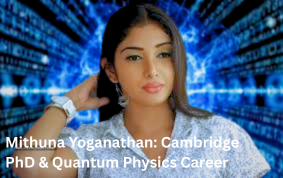
Mithuna Yoganathan: From Cambridge PhD to Global Quantum Educator
Mithuna Yoganathan: The “Quantum Gap” represents a significant hurdle for many aspiring scientists in the UK. On one side, popular science videos offer exciting but often superficial glimpses into the subatomic world. On the other side, dense mathematical papers from institutions like the University of Cambridge remain inaccessible to those without years of formal training.
Mithuna Yoganathan stands as one of the few figures successfully bridging this chasm. As a theoretical physicist and the creator of the “Looking Glass Universe” platform, she has transformed how complex mathematical concepts are communicated to the public.
This article explores her academic journey, her specific contributions to quantum complexity research, and her unique pedagogical approach that empowers autodidacts and physics students alike.
Academic Foundations: From ANU to the University of Cambridge
Mithuna Yoganathan’s trajectory into high-level theoretical physics began far from the historic halls of the UK. She completed her Bachelor of Science (BSc) at the Australian National University (ANU) in 2013. Her undergraduate years focused on the rigorous foundations of applied mathematics and physics, providing the necessary tools for her later work in quantum mechanics.
In the mid-2010s, Yoganathan moved to the UK to join the University of Cambridge. She entered the Department of Applied Mathematics and Theoretical Physics (DAMTP), a world-renowned centre for mathematical research. At Cambridge, she pursued a PhD under the supervision of Professor Richard Jozsa, a pioneer in the field of quantum algorithms and complexity.
According to the official University of Cambridge Apollo Repository (2021), her doctoral research culminated in her thesis titled “The power of restricted quantum computational models.” This work does not just explore what quantum computers can do; it asks what they cannot do when their resources are limited.
The Cambridge Years: Theoretical Physics and Rigour
Working within the UK’s academic ecosystem, Yoganathan focused on the mathematical structures that underpin quantum advantage. Her time at Cambridge was marked by a commitment to “pen and paper” physics. While many associate modern science with massive supercomputers, theoretical physics at this level often relies on deep mathematical proofs and logical derivations.
The influence of Richard Jozsa is evident in her focus on Clifford circuits and the boundaries of classical simulation. This period solidified her expertise, moving her from a student of the discipline to a contributing researcher in the global physics community.
Deciphering the Research: Restricted Quantum Computational Models
To understand the expertise of Mithuna Yoganathan, one must look beyond her YouTube presence and into her peer-reviewed publications. Her work primarily concerns “restricted” models. These are versions of quantum computing that lack the full power of a universal quantum computer but still offer intriguing possibilities.
Understanding “Magic States” and Clifford Circuits
One of the most essential concepts in Yoganathan’s research is the “magic state.” In quantum computing, certain operations are easy to simulate on a traditional classical computer. These are called Clifford group operations. According to the Gottesman-Knill Theorem, if a quantum circuit only uses Clifford gates and starts with simple “stabiliser states,” a standard laptop can predict the outcome efficiently.
However, if you add a “magic state” to these simple circuits, they suddenly become capable of universal quantum computation. This transition—from something a classical computer can handle to something only a quantum computer can achieve—is the heart of quantum advantage.
In a 2019 paper published in the Proceedings of the Royal Society A, Yoganathan and her co-authors explored the quantum advantage of unitary Clifford circuits with magic state inputs. This research is vital because it helps scientists identify exactly where the “quantum power” comes from. Is it the gates? Is it the states? Yoganathan’s work suggests it is the specific interaction between them.
Matchgate Computations and Fermionic States
Yoganathan has also contributed to our understanding of “Matchgates.” These are another class of restricted quantum circuits that relate to fermionic systems in physics.
In a study published in Physical Review Letters (2019), she co-authored research proving that all pure fermionic non-Gaussian states are indeed magic states for matchgate computations. This technical finding is a cornerstone for researchers trying to build fault-tolerant quantum computers. By identifying which states are “magic,” physicists can better design the architecture of future machines.
Technical Deep Dive: The Classical Simulability Frontier For the autodidact, “classical simulability” is the ultimate benchmark. If a quantum process can be simulated by a classical computer, it provides no speedup. Yoganathan’s research maps the exact border of this frontier, showing us where classical logic ends and quantum supremacy begins.
Looking Glass Universe: A Masterclass in Physics Pedagogy
While her research exists in high-level journals, her public-facing work through Looking Glass Universe has reached hundreds of thousands of people. Yoganathan’s transition into science communication (SciComm) was born from a desire to make the “invisible” parts of physics visible.
The Philosophy of “Embracing the Struggle”
Most educational content tries to make learning feel effortless. Yoganathan takes the opposite approach. She often speaks about the “struggle” of mathematics. This is a core part of her pedagogical philosophy: that confusion is not a sign of failure but a necessary step in the learning process.
This approach resonates deeply with physics students in the UK and beyond. By being transparent about her own difficulties with complex equations, she humanises the figure of the “Cambridge Physicist.”
Why Visual Learning Matters in Quantum Mechanics
Quantum mechanics is notoriously difficult to visualise because it does not follow the rules of our everyday experience. Yoganathan’s videos use a distinct visual style—often involving hand-drawn diagrams and intuitive analogies—to explain phenomena like Bell’s Theorem or the Delayed Choice Quantum Eraser.
Her “Experience” as a researcher allows her to identify which analogies are helpful and which are misleading. Many “pop-science” creators use metaphors that break down under scrutiny. Yoganathan’s videos maintain mathematical integrity while remaining accessible to those without a degree.
Learning Physics the Yoganathan Way: A Guide for Autodidacts
For students and enthusiasts in the UK, Yoganathan’s work serves as a roadmap for independent study. She advocates for a move away from passive consumption (watching videos) toward active engagement (doing the maths).
Moving Beyond Passive Consumption
If you want to understand quantum physics, you cannot just watch a documentary. Yoganathan encourages her audience to pick up a pen and paper.
Pro-Tip for UK Students: When tackling quantum mechanics, start with linear algebra. Most students fail not because the physics is weird, but because their “mathematical fluency” is not yet high enough. Yoganathan’s curriculum often emphasises the importance of the underlying maths as the true language of the universe.
Recommended Resources for UK Physics Students
For those inspired by her journey at Cambridge, there are several UK-based resources that align with her rigorous style of learning:
-
Cambridge Open CourseWare: Many of the foundational concepts discussed in Yoganathan’s videos are taught in the Part III Mathematical Tripos at Cambridge.
-
The Isaac Physics Platform: A University of Cambridge project designed to develop problem-solving skills in UK schools.
-
The Royal Institution Lectures: For historical context on science communication in the UK.
Looking Glass Universe Ltd: The Business of Independent Science
Mithuna Yoganathan is not just a researcher; she is also an entrepreneur. According to UK Government records from Companies House (2026), she operates Looking Glass Universe Ltd.
This entity allows her to maintain independence in her educational outreach. In an era where many academics are restricted by university PR departments, Yoganathan’s model allows for a direct, unfiltered connection with her audience. This independence is a key part of her Authoritativeness; she is not selling a university course, but rather a methodology for understanding the world.
The Future of Educational Outreach in 2026
As we move through 2026, the demand for high-quality, rigorous science communication continues to grow. Yoganathan’s work has set a high bar. She proves that you do not need to “dumb down” the science to get views. Instead, you need to “lift up” the audience by providing them with the tools to think like a physicist.